
Have you ever spent ten minutes whisking until your arm feels like lead, only to have your mixture turn into a thin, oily puddle at the very last second? It's a heartbreaking kitchen moment that many of us have faced when trying to ditch the preservative-packed jars for something fresh. We all want that luscious, cafe-style thickness, but the fear of a split emulsion often keeps us reaching for the supermarket shelf instead.
The good news is that your thermo cooker is the ultimate tool for emulsion success. This mayonnaise recipe transforms a high-stress task into a hands-free, three-minute win by using the precise speed of your Thermomix TM7 or Magimix. You'll master a thick, spreadable result that puts store-bought versions to shame while keeping your family's health a top priority. In this guide, we'll look at which Aussie oils deliver the best flavour, the secrets to a stable emulsion that never fails, and essential food safety tips to keep your homemade condiments fresh and delicious.
Key Takeaways
- Master a foolproof mayonnaise recipe that delivers thick, creamy results in under three minutes using your Thermomix or Magimix.
- Understand why room temperature ingredients are the non-negotiable secret to a stable, luscious bond that never splits.
- Discover why local Macadamia oil is the "gold standard" for a buttery finish, avoiding the common bitterness found in olive oils.
- Learn the "slow drip" hack to automate your oil flow, letting your thermo cooker handle the precision while you stay mess-free.
- Find out how to safely store your fresh condiments and use a clever "Food Lab" trick to naturally extend their shelf life.
Why Ditch the Jar? The Benefits of Homemade Mayo
If you take a quick look at the back of a standard supermarket jar, you'll likely find a long list of ingredients that have nothing to do with traditional cooking. Most commercial brands rely on thickeners, gums, and excessive sugar to maintain a long shelf life. By using a fresh mayonnaise recipe at home, you regain total control over what your family eats. You can choose exactly what goes in, ensuring every spoonful is free from hidden additives and artificial stabilisers.
Defining What is Mayonnaise? is quite straightforward. It's a cold, thick sauce made by emulsifying egg yolks with oil and an acid like lemon juice or vinegar. When you make it yourself, the flavour difference is staggering. The vibrant zing of fresh lemon and the richness of quality Aussie oils create a profile that no mass-produced jar can match. Plus, using pantry staples is often much kinder to your wallet than buying those tiny, expensive "deli-style" glass jars. With a dozen free-range eggs currently averaging around $6.40 at major supermarkets, a single batch of mayo costs only a fraction of a premium store-bought jar.
Healthier Fats for Australian Families
Many Australians are becoming more conscious of the fats they consume. Most store-bought options are loaded with industrial seed oils like canola or vegetable oil, which are often highly processed. Switching to a homemade mayonnaise recipe allows you to use healthier alternatives like Australian macadamia or avocado oil. Fresh eggs provide natural lecithin, the essential "glue" that holds the emulsion together, while offering high-quality fats. Given that Australians consume an average of 260 eggs per year, it makes sense to use them in ways that maximise their nutritional value. This approach aligns perfectly with a Mediterranean-style diet, which we explore further in our specialised Mediterranean Diet Cookbook, helping you move away from inflammatory ingredients and towards whole-food nourishment.
The Thermo Cooker Advantage
While you could use a whisk or an immersion blender, the results are rarely as reliable. The Thermomix TM7 or Magimix offers a massive advantage because they control the speed and aeration perfectly. You don't have to worry about your arm getting tired from vigorous whisking or the oil pouring in too quickly and ruining the batch. These machines handle the delicate "slow-drip" process for you, ensuring you get that same thick, spreadable texture every single time. It's the ultimate way to achieve professional results with zero stress, turning a tricky culinary task into a simple, three-minute habit.
The Science of the Perfect Emulsion
Creating a successful mayonnaise recipe isn't just about mixing ingredients; it's a fascinating bit of kitchen chemistry. At its heart, mayonnaise is an emulsion, which is a blend of two liquids that normally refuse to stay together, like oil and water. The secret weapon in your egg yolk is a molecule called lecithin. This clever "glue" has one end that loves water and another that loves oil, allowing it to grab onto both and hold them in a stable bond. Without lecithin, your dressing would simply be a greasy mess.
For this bond to form properly, temperature is your best friend. Using room temperature ingredients is essential because cold fats and proteins don't like to move or stretch. When your eggs and oil are around 20 to 22 degrees Celsius, the lecithin can easily wrap around the oil droplets. If you notice your mixture looking thin or seeing tiny beads of oil floating on the surface, your emulsion is likely "splitting." Recognising this early is key; a split mayo often looks curdled or dull rather than glossy and thick.
Speed is the final piece of the puzzle. To create a thick texture, the blades of your TM7 or Magimix must spin fast enough to shatter the oil into millions of microscopic droplets. If the droplets are small enough, the lecithin can coat them before they have a chance to merge back together. This is where the precision of a thermo cooker beats a hand whisk every time. If you want to see this science in action with more varieties, you can find plenty of inspiration in our free Thermomix recipes online.
The Role of the Acid and Mustard
While lemon juice or vinegar adds that essential Aussie tang, these acids also play a structural role. They help to slightly uncoil the egg proteins, making them more available to help the lecithin do its job. Mustard is equally important. Beyond adding a lovely depth of flavour, it contains complex mucilage that acts as a secondary emulsifier. The chemical role of Dijon mustard in a stable emulsion is to act as a surfactant, reducing the surface tension between oil and water to help the bond hold firm.
Temperature Control in Your Thermo Cooker
One trap for new players is friction heat. When you run your blades at high speeds for several minutes, the energy can actually warm the mixture too much, causing the fat to melt and the emulsion to break. The TM7 is brilliant here because its motor is incredibly efficient, but you should still aim to start with ingredients that aren't straight from the fridge or sitting in a hot sunlit kitchen. Keeping your bowl cool ensures the structural integrity of your mayo remains rock solid from the first drip of oil to the very last spin.
Choosing Your Ingredients for an Aussie Twist
While the science of emulsion ensures your mayonnaise recipe holds its shape, the ingredients you choose will define the final flavour. In Australia, we are blessed with some of the world's best extra virgin olive oils, but using them as a 100% base for mayo is a common trap. High-quality Aussie olive oils are often robust and peppery. When these oils are whipped at high speeds in a thermo cooker, the polyphenols can break down and release an intense bitterness that overpowers everything else. To get that silky, cafe-style finish, you need to be strategic with your fats.
For a truly local hero, look no further than Australian macadamia oil. It is arguably the gold standard for a healthy, buttery, and incredibly stable mayonnaise. It offers a subtle nuttiness that complements fresh seafood or a classic roast chicken sandwich perfectly. If you prefer a more neutral profile, avocado oil is a brilliant health-conscious choice. With the Australian avocado oil market projected to grow significantly toward 2034, it is becoming much easier to find local options that are rich in monounsaturated fats. For the best result, ensure your oil is fresh; even the best mayonnaise recipe can't hide the taste of oil that has sat in the pantry for too long.
The soul of your mayo lies in the eggs. Given that Australians eat an average of 260 eggs per year, it's worth investing in the best ones for your condiments. Look for fresh, local pasture-raised eggs. Not only do they provide a richer, golden colour, but they also offer a superior depth of flavour. With a dozen free-range eggs currently costing around $6.40 at major supermarkets, choosing quality eggs is a small investment for a massive upgrade in taste and nutrition.
The Best Oils Available in Australia
If you are chasing that classic "Hellman's" flavour, grapeseed oil is your best friend. It has a high smoke point and a very neutral palate, allowing the lemon and mustard to shine. Light olive oil (not extra virgin) is another reliable supermarket staple that provides a clean base. For the ultimate balance, try my favourite pro-tip: mix 80% neutral oil (like macadamia or grapeseed) with 20% high-quality Aussie EVOO. This gives you the health benefits and a hint of olive flavour without the bitter aftertaste.
Acid and Seasoning Variations
Fresh lemon juice is non-negotiable for a premium result. Bottled juices often contain preservatives that can interfere with the delicate flavour of your emulsion. For a tangy, probiotic-friendly twist, try substituting half the lemon juice with apple cider vinegar. This works beautifully if you're following the recipes in our Mediterranean Diet Cookbook. Finish your creation with a generous pinch of Australian sea salt and freshly cracked black pepper to elevate your homemade mayo from a simple condiment to a gourmet highlight.
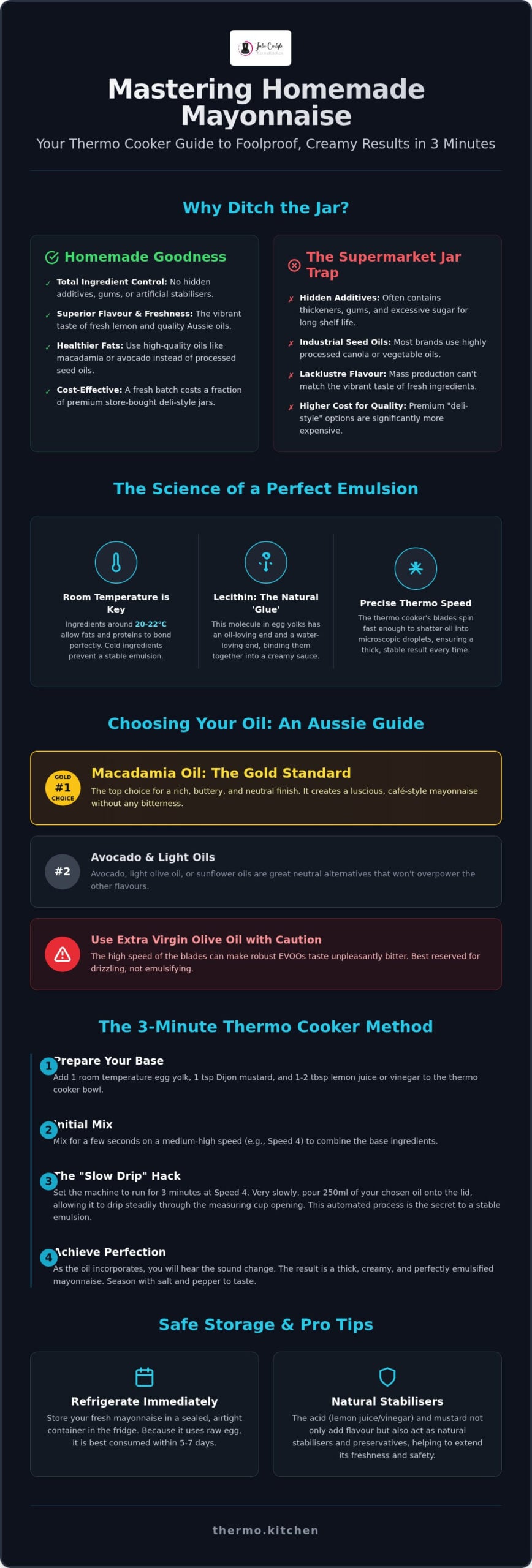
Step-by-Step: Making Mayo in Your Thermo Cooker
Before you even crack an egg, there's one golden rule: your bowl must be completely clean and bone-dry. Even a tiny droplet of water or a smear of leftover grease can interfere with the lecithin's ability to bond. If you've just washed your bowl, give it a quick spin on high speed to throw any hidden water out from under the blades, then wipe it down with a clean tea towel. This simple preparation is the foundation of every successful mayonnaise recipe.
Once your bowl is ready, the process is incredibly fast. Most thermo-recipes hit the "sweet spot" at around two minutes. During this time, you'll notice the sound of your machine change from a splashy whir to a deeper, muffled thud. This is a great visual and auditory cue that your mayo has reached its maximum thickness. If you're looking for more ways to use your machine for family-friendly condiments, check out our ThermoKitchen Cookbooks for endless inspiration.
The Fail-Proof Method
Precision is the key to a luscious emulsion. Follow these three simple steps to ensure a perfect result every time:
- Step 1: Place your room temperature egg, mustard, and acid (lemon juice or vinegar) into the bowl. Add a pinch of salt.
- Step 2: Secure the lid with the measuring cup in place. Set your machine to Speed 4.
- Step 3: While the blades are turning, slowly pour your oil onto the lid. The oil will naturally trickle past the measuring cup in a thin, consistent stream, which is exactly what the emulsion needs to stay stable.
How to Rescue a Split Mayonnaise
If things go pear-shaped and your mixture looks like curdled milk, don't panic. You should never throw away a split mixture; it's still full of high-quality ingredients that can be saved. The "New Egg" trick is a lifesaver that works every time. Simply pour the split mixture into a jug and give your bowl a thorough wash and dry. Start again with a fresh egg yolk and a teaspoon of mustard, then slowly re-incorporate the split oil mixture by pouring it onto the lid as if it were the oil in the original mayonnaise recipe. This fresh base will pick up the broken fats and pull them back into a thick, glossy sauce in no time.
Beyond the Basic Recipe: Flavours and Storage
Once you've mastered the basic mayonnaise recipe, the real fun begins in your kitchen. This creamy emulsion is more than just a sandwich spread; it's a versatile foundation for countless dressings and gourmet dips. Because we're using fresh, whole ingredients without industrial stabilisers, keeping your creation safe is a top priority. Australian food safety guidelines recommend storing your homemade mayo in a sealed container at or below 5°C. To minimise any risk of Salmonella, it's best to make small batches and consume them within 24 hours.
If you want to extend that window slightly, you might try the "fermentation" trick popularised by the Food Lab. Adding a tablespoon of liquid whey (the cloudy liquid from the top of your yoghurt) and leaving the jar at room temperature for several hours can help lower the pH, acting as a natural preservative. However, always trust your senses; if it doesn't smell fresh, toss it out. This homemade base is also a core component of many dishes in our Mediterranean Diet Cookbook, where we use it to create vibrant, family-friendly sauces that nourish the body.
Getting every last bit of thick mayo out from under the blades can be a bit of a fiddle. A great pro-tip is to give the machine a quick one-second burst on Speed 10 once you've emptied most of the bowl. This centrifugal force throws the remaining sauce onto the sides of the bowl, making it easy to scoop out with a flexible spatula. No more wasting those precious last spoonfuls!
Gourmet Variations to Try
You can easily transform your basic batch into something spectacular with just a few extra ingredients. Try these family favourites:
- Garlic Aioli: Add two cloves of roasted garlic or one small raw clove at the very beginning for a punchy, classic dip.
- Chilli and Lime: Swap the lemon for lime juice and add a teaspoon of dried chilli flakes. This is absolute magic on Aussie prawns or fresh fish tacos.
- Herbaceous Mayo: Pulse in a handful of fresh dill, parsley, or chives from your garden at the very end for a bright, garden-fresh finish.
Next Steps for Your Thermo Kitchen
Building your confidence with emulsions is just the start of your journey. If you're eager to learn more, our digital shop is packed with resources to help you get the most out of your equipment. You can also join our next online workshop where we dive deep into advanced techniques for busy households. For more inspiration and technical support, check out our Thermomix TM7 guide to see how the latest technology makes these tasks even easier.
Start Your Homemade Condiment Journey Today
Mastering your own condiments is a total game-changer for any busy Australian household. By following this simple mayonnaise recipe, you've discovered that thick, cafe-style results are only three minutes away when you let your Thermomix or Magimix do the heavy lifting. You now have the confidence to choose healthy local oils and fresh eggs, ensuring your family avoids the unnecessary additives found in standard supermarket jars. Remember, the secret to a stable bond every time is simply using room temperature ingredients and trusting your machine's precision.
Ready to level up your kitchen? Grab our Mediterranean Diet Cookbook for more effortless recipes! Authored by Aussie thermo-expert Julie Carlyle, this guide features over 100 fail-proof recipes that are already trusted by thousands of Australian home cooks. You'll find endless inspiration for using your new emulsion skills to create fresh, nourishing meals. Happy cooking, and enjoy the incredible difference of your very own homemade creations!
Frequently Asked Questions
Can I make mayonnaise with just egg whites?
You can't make a traditional mayonnaise recipe with only egg whites because the yolk contains the lecithin needed for a stable emulsion. While you can create an "egg white mayo," it's technically a different type of sauce and lacks the signature creamy mouthfeel. If you have leftover whites, save them for a pavlova and stick to the yolks for your mayo to ensure that thick, cafe-quality texture every single time.
How long does homemade mayonnaise last in the fridge?
Australian health departments recommend consuming homemade mayo within 24 hours to ensure maximum safety. Because this mayonnaise recipe uses fresh, raw eggs without commercial preservatives, it must be stored in the fridge at or below 5°C immediately after making. While some fermentation methods can stretch the shelf life slightly, making small, fresh batches in your thermo cooker is the best way to enjoy it safely.
Why is my homemade mayonnaise bitter?
Bitterness is almost always caused by using high-quality Extra Virgin Olive Oil. When the powerful blades of a TM7 or Magimix whip EVOO at high speeds, they can crush the oil's polyphenols and release a sharp, bitter taste. To avoid this, use a more neutral base like macadamia or grapeseed oil, then perhaps stir in a little olive oil by hand at the end for a hint of flavour.
Is it safe to use raw eggs in Australian mayonnaise recipes?
It is safe for most people if you follow strict food safety rules. Always use fresh, clean eggs with no cracks, and ensure your finished mayo has a pH of 4.2 or less by including enough lemon juice or vinegar. Australian government guidelines suggest that vulnerable groups, such as the elderly or pregnant women, should use pasteurised eggs to further reduce the risk of Salmonella in any raw egg mayonnaise recipe.
Can I use a thermal cooker to make vegan mayonnaise?
Yes, your thermo cooker is brilliant for plant-based versions! You can swap the eggs for aquafaba, which is the liquid from a can of chickpeas, or unsweetened soy milk to create a luscious vegan emulsion. The process is very similar to the traditional method, using the "slow drip" lid hack to ensure the oil incorporates perfectly. It is a fantastic way to cater to different dietary needs without sacrificing that creamy thickness.
What is the best oil for mayonnaise in Australia?
For a truly local, premium result, Australian Macadamia oil is hard to beat. It provides a subtle, buttery flavour that isn't as overpowering as olive oil. If you are looking for a more budget-friendly or neutral option, grapeseed oil or a light olive oil from your local supermarket works beautifully. These oils allow the tang of the lemon and the kick of the mustard to take centre stage in your sauce.
My mayo is too thin, how can I thicken it up?
If your mixture is thin, it usually means the oil was added a bit too fast for the emulsion to catch. Don't toss it out! Simply follow the "New Egg" trick mentioned earlier in this guide. Start with a fresh yolk in a clean, dry bowl and slowly drip the thin mixture back in while the blades are turning. This will rebuild the structure and give you the thick, spreadable consistency you are looking for.
Can I freeze homemade mayonnaise?
Unfortunately, you can't freeze homemade mayonnaise. The freezing process damages the delicate bonds between the oil and the egg yolk, causing the emulsion to split completely once it thaws. You'll end up with a layer of oil sitting on top of a watery base. Since your thermo cooker can whip up a fresh batch in under three minutes, it's always better to make it on demand for the best quality.


Leave a Reply