

Estimated reading time: 19 minutes
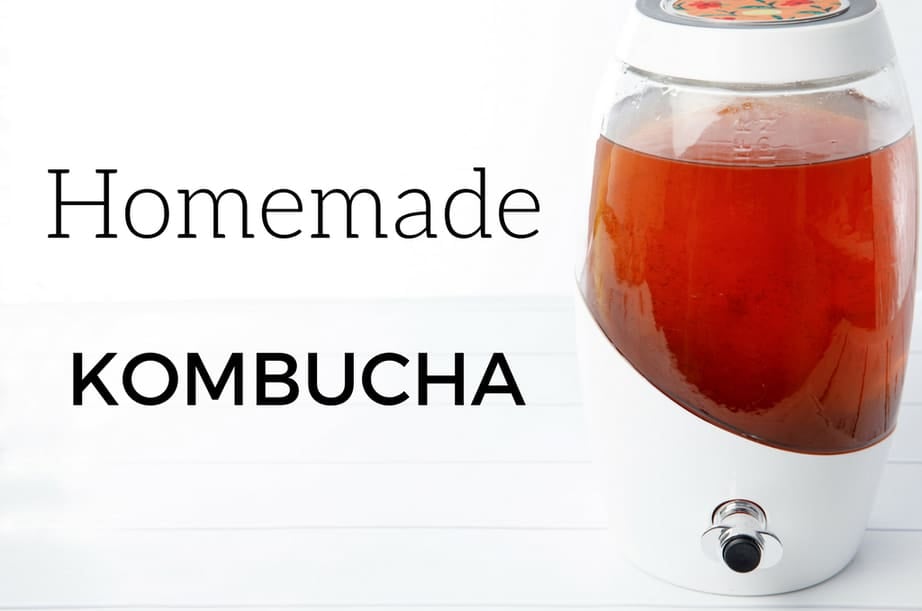
Kombucha is a probiotic drink produced by fermenting tea and sugar with a SCOBY and strong liquid Kombucha from a previous batch. I can show you how to make Kombucha and you will never need to buy it again.
Key Takeaways
- Kombucha is a probiotic drink made by fermenting tea and sugar with a SCOBY that offers numerous health benefits.
- To make Kombucha, use bottled water, sugar, black tea, and a SCOBY starter; avoid tap water and honey for best results.
- Kombucha requires precise brewing processes, including maintaining stable temperatures to ensure healthy fermentation.
- Homemade Booch is superior to commercial Kombucha because it contains active microbial cultures and more nutrients.
- The article provides step-by-step guidance and troubleshooting tips to help you successfully make Kombucha.
Table of contents
What is Kombucha?
Kombucha is a probiotic tea made by adding a fermented liquid and SCOBY to a sweet black or green tea. After 1-2 weeks, the result is a drink that is tangy and slightly fizzy. The fermentation has reduced the sugar and created a nutrient and probiotic-rich drink with many potential health benefits.
What is a SCOBY?
SCOBY stands for Symbiotic Colony of Bacteria & Yeast. It is a the bi-product of the fermentation. Each time a new batch of Kombucha is made, a new SCOBY will form.
How do you make Kombucha?
When I first asked this question, I was given vague instructions to brew a strong, sweet tea, wait for it to cool, and add it to the jar of SCOBY. Whilst this is essentially correct, there were nowhere near enough details for me to feel confident. After all, a SCOBY looks pretty gross, so it was going to take a leap of faith for me to drink the liquid under the growth anyway... I wanted very precise instructions.
The precise instructions on how to make a basic Kombucha were never found. In the beginning, I didn't even know where to find a SCOBY, or the meaning of a "SCOBY Hotel." The only answer was to research it myself. Remember this was 20 years ago! I was sure I was doomed to fail. My Kombucha success has come through asking a lot of questions, reading the masters, trial and error, fruit fly infestation, and a few other mishaps. In this article, I am giving you the absolute basics of making your own Kombucha.
Kombucha Basic Ingredients
The recipe is for the basic kombucha ferment. It will produce a tasty Kombucha, which makes a nice drink, and can be used as a blank slate for a secondary ferment.
Water
- This may sound like a no-brainer, but it can't be tap water. Tap water is chlorinated, contains fluoride, and, depending on where you live, various other minerals that can interfere with the success of your Kombucha ferment. Use ordinary bottled water with nothing added.
Sugar
- Please don't skip or reduce the sugar. So many people take it upon themselves to try a sugar-free Kombucha. The sugar isn't for you. The sugar is to feed your growing organisms. If you don't feed it, like any pet, it will die. You can choose to use white sugar or caster sugar. Avoid using honey, as it has microbial properties and can compete with your Scoby microbes.
Black Tea
- Lovely normal, nothing fancy, cheap as chips black tea. Choose loose-leaf tea and brew a very strong batch. This is not when you experiment with green tea, rosehip tea, Earl Grey or other perfumed teas. This can come later. First, we establish a healthy, robust Kombucha that has proved itself over a few batches and has a strong scoby and tart liquid developing.
SCOBY Starter
- Here is where you need to beg borrowing or steal. You can't start a Kombucha batch from thin air. There are too many other opportunistic bacteria in the environment ready to take over your ingredients and see what they can concoct. My advice is to go to a reliable source and purchase one. I have always used Nourish Me Organics for all my living organisms and auxiliary equipment.
Kombucha Troubleshooting
What can go wrong with your Kombucha? My first kombucha was a disaster! I just used a large jar covered in cheesecloth and failed miserably. I killed the SCOBY and had a fruit fly infestation. However, these mistakes taught me the importance of a good setup.
Two things went wrong:
- The flimsy cover let fruit flies into the Kombucha batch. Fruit flies love the smell.
- I had been given some scoby and a tiny amount of booch, and I proceeded to fill the container, thinking that would be enough to make litres of Kombucha.
It wasn't that the Kombucha never formed a good SCOBY, just a very thin one, the liquid remained very sweet, and eventually I had "wringlers" that turned into fruit flies. This wouldn't be my last run-in with fruit flies. But there was nothing to salvage. If this happens, everything needs to be stripped down and put through the dishwasher.
How to make Kombucha F2 or Secondary Ferment
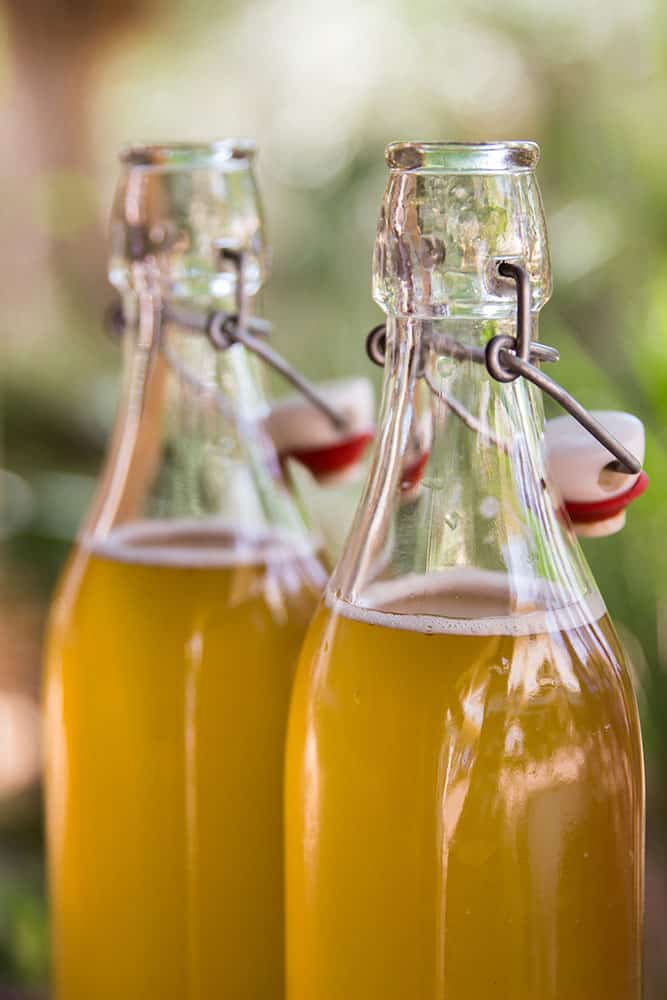
Doing a secondary ferment is how you add additional flavours and some bubbles. The secondary ferment isn't necessary, but most commercially prepared Kombuchas are sold with additional flavours. I have a detailed article on taking your Kombucha tea to the secondary ferment stage.
Personally, I drink both the first and secondary ferments, so I have both in the fridge at any given time. It's best to get confident with making Kombucha first. I like to have a well-stocked SCOBY hotel before I start experimenting.
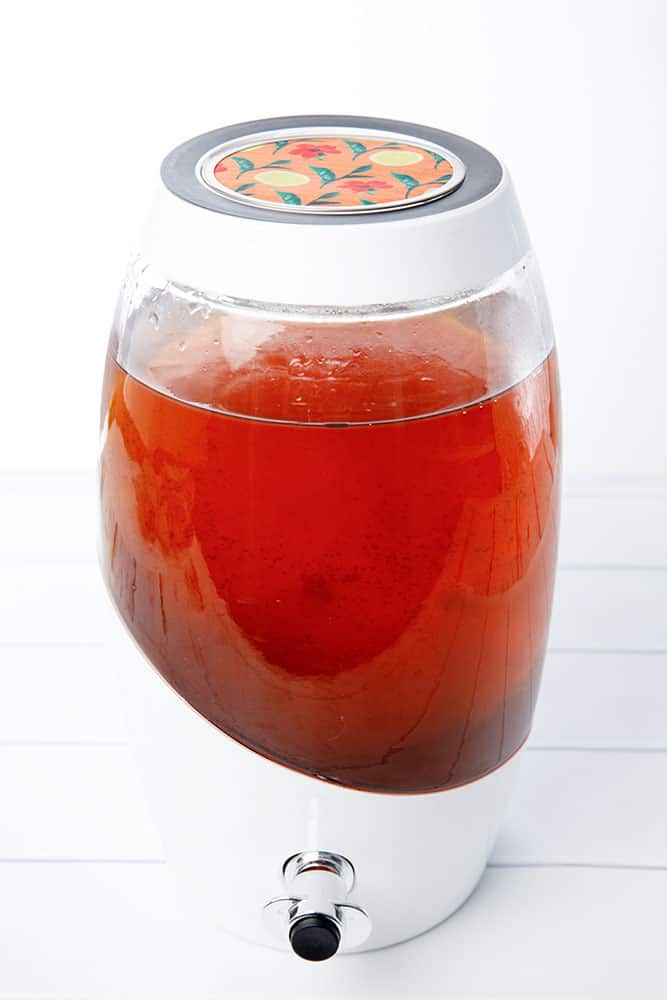
to make Kombucha successful! This is one of the two setups I use now to make my Kombucha brew.
Tips and Hints to Make Kombucha
- Go for a crock with a tap so that you can test the fermentation as it progresses without disturbing the SCOBY on top.
- Make sure the tap is removable for cleaning. This is very important as ooglies (baby SCOBY) can form in the tap and stop the flow of liquid. Cleaning is also essential for hygiene. The kit above has a removable tap.
- Use bottled spring water with no chlorine. Chlorine kills bacteria, even our good bacteria.
- Plain organic black tea or green tea without flavourings is best.
- Use white sugar, not brown sugar or honey (honey has its own good bacteria).
- Place an additional cloth over the vessel as the second protection against fruit flies. (don't use cheesecloth, the fruit flies can find their way in!)
- Don't move the fermentation crock once you add the tea. The SCOBY is alive and doesn't like to be moved too much.
- Cover the crock if it's in direct sunlight, as sunlight kills bacteria.
How do you know if your Kombucha is Cold?
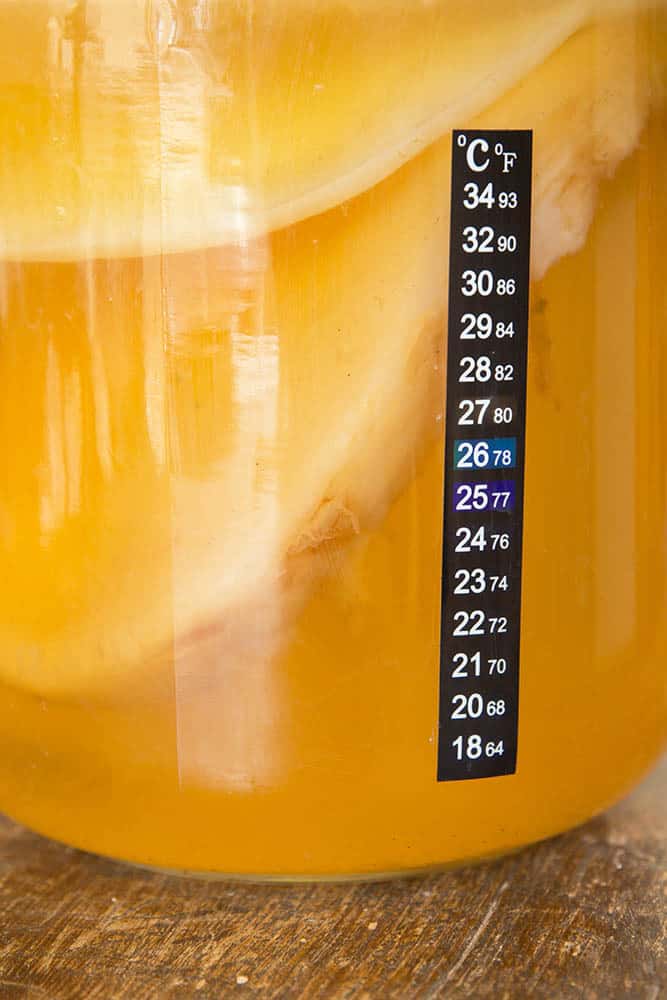
If your Kombucha is taking more than a week to sour or the SCOBY is slow to grow, it may need additional heat. I have a complete article on how to keep your kombucha warm. The ferment needs to be kept at a temperature between 24 -29 degrees Celsius (75 -85 F). A heat mat may be necessary for winter. If you're worried about temperature control, a thermometer can be handy. I have a few that are designed for the purpose for $3.00 plus postage. Just check my shop. Some Kombucha crocks have a built-in temperature gauge, which is a godsend in winter.
What happens if my Kombucha is too Cold?
The problem with the Kombucha becoming cold is that the bacteria weaken. They eat less and don't multiply. This leaves them susceptible to opportunistic bacteria like mould, yeast overgrowth from the sugar and any other pathogen. So it is important to act quickly if you think your Symbiotic culture is not getting all of the optimum growing conditions. Read my article on how to keep your Kombucha warm in winter.
It may look like a bit of a process, but once you get set up, it's simple to make Kombucha in your own home. Best of all, it's as cheap to make as a cup of tea. No more expensive purchased Kombucha, and you know your Booch is alive and feeding your body valuable probiotics.
Homemade Booch V's Commercial Kombucha?
Homemade Booch is consumed at its prime. The microbial activity is still active and multiplying. When I buy commercially prepared Kombucha, I'm concerned it will be inferior to my homemade product. I wonder if the process of bottling, transporting, storing and selling commercially produced Kombucha will result in a decline of valuable bacteria and nutrients.
What do you think? Do you make your own Booch? Will you give it a go? Do you have any questions for me? Please feel free to share your experiences in the comments.
I have created a helpful Kombucha Recipe chart with conversions for different volumes, which may be handy. When I first started making Kombucha, I found that all measurements were in gallons. So it was a little challenging.
P.S I got my complete kit at Nourish Me Organics, which included a luscious SCOBY 🙂
Kombucha FAQ
Kombucha can have a very small amount of alcohol due to the fermentation process. Commercially produced Kombucha must be .5% to 1.5%. Some people are sensitive to this.
Once the Kombucha tastes the way you like it, it's best to put it in an alternative container and store it in the fridge. If it stays at room temperature, it will continue to ferment.
Yes, you probably had one of the little ooglies that continues to be produced even in the fridge. These are perfectly safe and just show how healthy and active your Kombucha is.
Yes, Kombucha is a fabulous, healthy drink. It supports your gut biome and helps to keep it diverse and healthy. If you do drink a lot of Kombucha a would suggest a straw. Like many drinks, it is acidic. For the sake of the enamel on your teeth, it's best to use a straw.
Kombucha is a probiotic drink. The microbes arrive in our gut alive and add to the diversity of the natural flora. Evidence shows that a diverse gut biome decreases inflammation and supports the immune system. Polyphenols are also present in kombucha, which are considered antioxidants.
Let's Connect!
Do you want to connect with other probiotic warriors? Join the DYI Fermenting FB group page and connect with others. I share loads of great recipes and tips on the page.
Also, if you would like to be notified when more probiotic recipes are released, please subscribe to our newsletter. We only send a newsletter to our friends when we have a recipe to share.
Kombucha Tea Recipe
Equipment
Ingredients
- 4 litres bottled spring water with no additives
- 2 ½ TBS organic black tea or green tea
- 1 cup white sugar
- 2 cups starter liquid with SCOBY
Instructions
- Pour one litre of water into a pot and heat on the hotplate until it boils.4 litres bottled spring water
- Add the tea and sugar to the boiled water and allow it to steep for 5 minutes.2 ½ TBS organic black tea or green tea, 1 cup white sugar
- Strain the tea and add the remaining 3 litres to the pot. Allow the tea to cool to room temperature.4 litres bottled spring water
- Place the SCOBY and starter liquid in your fermenting vessel.2 cups starter liquid with SCOBY
- Pour the lukewarm tea over the SCOBY.
- Cover the fermenting vessel with the supplied lid and a cloth. (Prevents fruit flies and sunlight)
- After 4 days start testing your Kombucha via the tap. When the flavour has soured to your liking the brew is ready for bottling or a second ferment.
- Bottle and refrigerate until required.
- Leave 500mls of starter liquid and the SCOBY in the fermenting vessel for your next batch. Do not refrigerate the fermenting vessel or SCOBY.
Notes
Log in: Then add your own recipe notes below!
Nutrition
I hope you have enjoyed this story. Feel free to leave a comment or start a discussion. If you have made a dish from this site, I would love to know what you thought!
Leaving a comment and a star rating helps others decide if they should try my recipe. Plus, if you hit the social media share buttons, your friends may find a delicious new recipe or Thermomix Tip too!
If you want to be notified when a new recipe is released, sign up for my monthly newsletter. The form is also in the footer!
Thank you for stopping by,
Happy Cooking
j xx

Link Disclosure
From time to time I recommend kitchen products and ingredients. These are always items I use and love! When I share a link to a product you can rest assured that I have tested the item and genuinely love it! If you follow my link and purchase the item in some cases I will receive a commission for the referral.
Whilst the commission may only be $1 or so, I value your support, and I take your trust very seriously.
By clicking on my link, or selecting my name "Julie Carlyle" as the referer you reward me with a small commission that helps support me and this website.
Your support keeps me cooking!
sarah says
I’ve never even had kombucha much less made it!
rae says
I think brewing kombucha in a jar with a tap could lead to problems. If plastic or metal on the inside of the jar touch the kombucha in could interefere.
Julie Carlyle says
Hi Rae, I understand your concern. The Kombucha set up I use has all food grade soft plastic on the inside of the jar which is attached to a tap on the outside with plastic seals. The metal doesn’t come in contact with the inside of the jar at all. I have been using this set up for over a year with no issues.
Mia Jenkins says
It’s my understanding that scobys should never be stored in the fridge. I’ve read that it weakens the scoby which may cause mould when used to brew again. And not always in the first cycle or 2. Better to just store at room temperature. Either with a solid plastic lid or a cloth and rubber band as for regular brewing. Just top with sweet tea as needed to keep the scobys covered.
Julie Carlyle says
Hi Mia, Thanks for stopping by ???? I don’t store my SCOBY in the fridge. Once the fermentation is complete I decant the Kombucha into bottles and then refrigerate my drink. The SCOBY is still in the brewing vessel. I top the brew up with more tea and the cycle continues. I’m sorry if I wasn’t clear. I agree, the SCOBY likes to stay in the range of 24-29 degrees for optimum health.
Kath says
Heaps of questions. I'm dying to start making my own kombucha. I've been making coconut water kefir for a while now but never 100% sure I'm doing my body any good as I used a powdered form of kefir starter, not the grains. So I,m ready to purchase all the kit and scoby etc but wondering a few things. When you store the scoby is it in just water or a tea mixture? Can I put it in a different jar in the liquid in the fridge while I clean the fermenting container? Do you have to use that quantity of sugar? How long can I store a scoby in the fridge? If my scoby creates babies and I want to give the babies to a friend, what's the safest method of doing that? How long might it take for babies to occur?
Julie Carlyle says
Hi Kath, Those are all fabulous questions.
The scoby is always stored in tea or leftover kombucha.
You can put the scoby into another jar (or bowl) and just leave it on the bench in some Kombucha whilst you clean the fermenting container.
Yes, you do need to use that much sugar as you're feeding the yeast and bacteria. There will be minimal residual sugar left at the end of the fermentation. You will know the fermentation is complete when the sugar taste has gone and there is a hint of vinegar.
The scoby can be stored in tea in the cupboard for quite a while. I have a scoby hotel stored in this way with all my scoby babies.
The scoby will usually produce a new baby during each new Kombucha batch. To store them to give to friends you will need to reserve 1 cup of the kombucha with a thick scoby in a jar. Keep the jar at room temperature.
I hope I've answered some of your questions. Feel free to drop by and ask more 🙂
Julie
Sandra Spokes says
My niece has just given me a Scooby and am going to try making my own ,but it looks and sounds really difficult ,I have been reading up a lot on thIs and will def give it a go thanks for all this great information ????
Julie Carlyle says
I'm so pleased this article is helpful, please feel free to ask any questions.
Viv Falcone says
Hi there,
I've been brewing my own kombucha for about 30 yrs now, & this is the first time I've heard of a second ferment.... how is this done please?
Previously, if I wanted flavours, I added fruit teas, & have always had good effervescence.
If you need to, you can freeze the scoby & boiling tap water will remove the chlorine.....
Julie Carlyle says
Hi Viv,
How fabulous that you have been brewing and drinking KOMBUCHA for so long. You would be a wealth of information. I had no idea you could freeze the SCOBY. That is so helpful!
A second ferment is when you bottle your KOMBUCHA and then add an additional flavor. For instance you can juice fresh ginger or turmeric and add a little to each bottle. You cap the bottle but leave it at room temperature. The yeast and bacteria go to work on the new sugar source and create
More bubbles and the KOMBUCHA gets additional flavour. The scoby has been removed so you aren't affecting the health of the scoby. With the second ferment you need to burp the bottles each day to prevent and explosion. After a couple of days you can refrigerate the bottles to stop the fermentation process.
I will do a complete story with recipes sometime this month.
Thanks so much for stopping by ????
Guylaine says
Since the first time I drank Kombucha, I've been completely charmed by this delicious beverage. One of my work colleagues brought some he made. His had a second ferment using strawberries. It was delicious. So funny that this afternoon I was working in my garden preparing the soil for planting, and I was thinking about how I could try to make some Kombucha...and tonight I see your publication! I love the idea of having a living organism in a bowl and using it over and over...just feeding the beast once in a while. In fact, I have sourdough sleeping in my fridge, always ready to be awakened! Do you know if it's possible to grow your own scoby, starting from scratch! Byou the way, I love your blog!
Julie Carlyle says
Thank you so much for your lovely comment! I was exactly the same as you! One mouthful and I never want to drink anything else. I love that I'm drinking a living drink that is feeding my body, and brewing it myself is so satisfying.
Micky says
You can use organic raw sugar which is better for you than white sugar, also do not use any metal utensils or containers with metal components as it will kill the scoby.
When you get spare scoby put them in a seperate storage jar with enough liquid to cover and feed them occasionally, can keep multiples in one jar (this is your scoby hotel) and is your backup if you have something happen to one of your scoby brews or to give away to friends/family.
Julie Carlyle says
Thanks for adding these tips. I will add "not using metal" to the story, I completely forgot to include that in the watch points. You"re completely correct about the raw sugar. The SCOBY does well on raw sugar. Thanks for stopping by and leaving a comment 🙂
Julia @ Happy Foods Tube says
I have never tried kombucha but lately I've been seeing it across the Internet. It sounds very interesting.
Annie Standing says
Thanks so much for this! I have wanted to make my own kombucha for ages, but like you, I couldn't find step by step instructions; will definitely be trying this!
Lisa | Garlic & Zest says
I've never even had kombucha much lessed made it! The Scoby sounds interesting -- I imagine like the weird mother that floats around in homemade vinegar. Beautiful photos!
Jenni says
What a great and useful article! I have never attempted to make kombucha because it seems so complicated and tricky - but great job making it seem simple!
Liz @ I Heart Vegetables says
We brewed kombucha a few years ago and it was so fun! We could never get ours as fizzy as the storebought kind, but it still tasted good!
Julie Carlyle says
Good on you Liz! There seem to be so many booch makers out there! I think the only way to get a good fizz it to do a secondary ferment in the bottle. I'm not a fan of the commercially prepared kombucha which has been carbonated.
Lesley Hodges says
Hello, where could I purchase one of the jars with the pourer you have pictured above please. Thanks
Julie Carlyle says
Hi Lesley,
I got my beautiful Kombucha jar and SCOBY starter from this distributor. I've now added the link to the story. It was available as a complete kit.